
Team Health

Measuring how your team actually operates — across eight dimensions of high performance.
WHAT IT MEASURES
The Team Health Assessment measures how a team functions across eight research-backed dimensions. Each captures something distinct about how high-performing teams operate — not what they produce, but how they work together to produce it.
- Shared Purpose & Clear Goals — Clarity on why the team exists, where it is headed, and how success is measured.
- Psychological Safety — Whether people feel safe to speak up, challenge ideas, admit mistakes, and take risks.
- Collective Accountability — Whether commitments are kept and ownership is shared — not left to the manager alone.
- Communication & Candor — Whether feedback flows in all directions and difficult conversations happen early.
- Continuous Learning — Whether the team regularly reflects, improves, and invests in growing collectively.
- Process & Autonomy — Whether the team has the clarity, autonomy, and efficient processes to do great work.
- Leadership Effectiveness — Whether the team is well led — direction is clear, people feel supported and developed.
- Results & Delivery — Whether the team consistently delivers, learns from shortfalls, and knows if it is winning.
WHAT IT RETURNS
Each dimension returns a percentage score. The three foundational dimensions — Psychological Safety, Shared Purpose & Clear Goals, and Collective Accountability — carry greater weight in the overall composite, as these determine whether everything else works. If any single dimension falls below 40%, the overall score is capped — a team cannot be classified as high-performing when a critical gap exists in a core area.
The overall Team Health score places the team in one of four classifications:
- High Performing Team (≥ 80%) — Trust and clarity embedded. Focus shifts to sustaining and raising standards.
- Developing Team (65–79%) — Strong foundations, identifiable gaps. Focused effort drives real change.
- Emerging Team (50–64%) — Building the habits and structures it needs. Improvement is possible.
- Team Requiring Attention (< 50%) — Critical gaps affecting performance. Structured intervention required.
The spread data — how much members disagree on each dimension — is often as revealing as the average. High disagreement means people are having fundamentally different experiences of the same team.
WHY IT MATTERS
Most teams have a general sense of what isn't working. What they lack is a shared, data-led view of it — one that gives everyone the same starting point for a difficult conversation. The Team Health Assessment makes the invisible visible.
The eight dimensions are specifically chosen because they represent the levers most within a team's control: behaviors that can be discussed, agreed upon, and changed without structural redesign.
HOW IT WORKS
Participants complete a 38-question survey in around 10–15 minutes. Before it goes live, the full question set is shared with the team leader — wording can be adjusted to fit the team's context, culture, and priorities. Results are broken down by sub-team, making it possible to see where experiences diverge across the organization. An Employee Advocacy score is included alongside the dimension results — a 0–10 measure of how likely team members are to recommend this team as a great place to work.
The results aren't an end point — they're a starting point. They feed into a facilitated workshop where the team builds a concrete action plan, followed by a 12-week individual coaching program for each leader (6 sessions), and a reassessment at 90 days that measures actual movement against the baseline.
The Team Health Assessment runs as part of a facilitated engagement — not as a standalone self-serve tool. To discuss running this with your team, contact us.
DISC Behavioral Profile
Understanding how people behave, communicate, and respond under pressure.
WHAT IT MEASURES
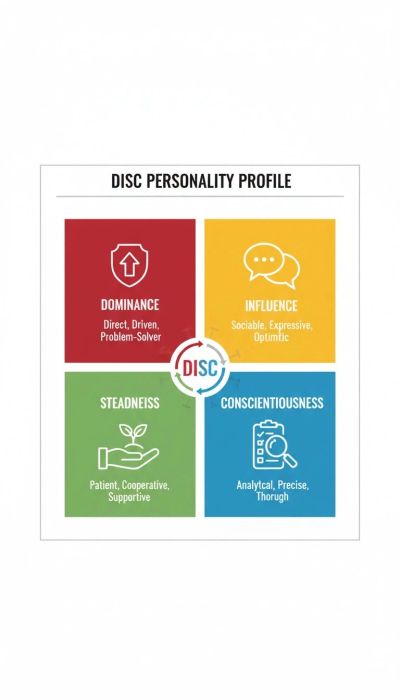
DISC measures behavioural style across four dimensions:
- Dominance (how you handle problems and challenges),
- Influence (how you handle people and contacts),
- Steadiness (how you handle pace and consistency), and
- Conscientiousness (how you handle rules and procedures).
It describes the "how" of behaviour — not personality, intelligence, or values — making it one of the most practical and immediately applicable assessment frameworks available.
WHY IT MATTERS
Behavioural style differences are the most common source of friction in teams and the most fixable. DISC gives individuals a shared language for understanding why people communicate and make decisions differently, and gives teams a practical map for working across those differences.
It is particularly powerful for improving communication, reducing unnecessary conflict, and helping leaders flex their approach.
HOW IT WORKS
The DISC assessment is completed online in around 10–15 minutes. There are no right or wrong answers — respondents choose from a series of word groupings that best and least describe how they naturally behave. Results are returned as a personalised behavioural profile report. In a coaching context, the report is reviewed together in a dedicated session, exploring what the profile reveals, where it is accurate, and where it surprises. The goal is not to label but to open a conversation about how you naturally operate and how that lands with others.
Enneagram Profile
Understanding core motivation, fear, and the deeper drivers of behavior.
WHAT IT MEASURES
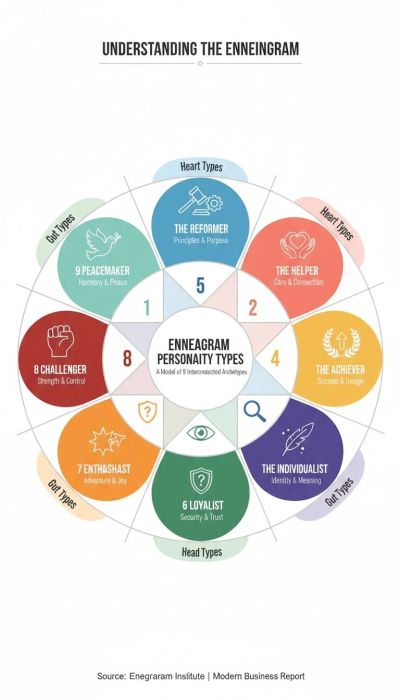
The Enneagram identifies nine distinct personality types, each defined by a core motivation, a core fear, and characteristic patterns of thinking, feeling, and behaving.
Unlike behavioral assessments, the Enneagram goes beneath the surface to explain why people do what they do, including under stress. It maps each type to one of three centres of intelligence (Head, Heart, Gut) and describes how individuals move under pressure (stress arrow) and when secure (growth arrow).
WHY IT MATTERS
Surface behaviour is relatively easy to observe; motivation is much harder to understand. The Enneagram accelerates empathy by helping people see that colleagues who behave frustratingly are not doing so out of malice, they are acting from a fundamentally different worldview and set of needs.
In teams, this shifts conflict from interpersonal to systemic, and opens conversations that would otherwise stay closed. It is particularly valuable for leadership development, team culture work, and coaching relationships where depth of self-understanding matters.
HOW IT WORKS
The Enneagram process begins with a typed questionnaire completed in advance, which surfaces likely type candidates. Because the Enneagram rewards self-recognition over algorithmic assignment, the results are reviewed in a dedicated coaching session — exploring the type descriptions in depth, testing them against real experience, and arriving at a type the client genuinely owns rather than one that has simply been assigned. This conversation is often one of the most revealing in a coaching engagement.
Emotional Intelligence (EI/EQ)
Measuring self-awareness and relational effectiveness across five domains
WHAT IT MEASURES
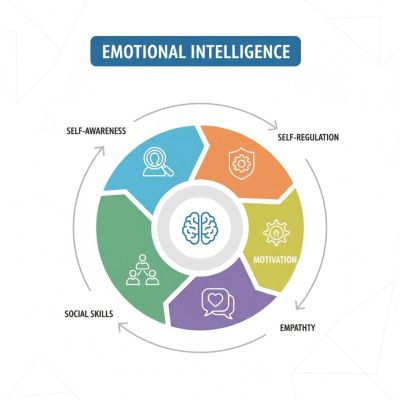
The EI assessment measures emotional intelligence across five domains established by Daniel Goleman:
- Self-Awareness (recognising your own emotions and their impact),
- Self-Regulation (managing disruptive emotions and impulses),
- Motivation (internal drive beyond external reward),
- Empathy (sensing and understanding others' emotions), and
- Social Skills (managing relationships and influencing effectively).
When also getting 360 degree inputs, contributors who know the participant also complete the assessment, enabling a direct comparison between self-perception and observed behaviour.
WHY IT MATTERS
Research consistently shows that EI is a stronger predictor of leadership effectiveness and career success than IQ alone. It is also the foundation of psychological safety, trust, and team performance.
Crucially, unlike many traits, Emotional Intelligence can be developed. It responds to intentional practice and focus.
The 360 component is particularly valuable because the gap between how we think we show up emotionally and how others actually experience us is one of the most common and consequential blind spots in leadership.
HOW IT WORKS
The EI assessment is completed online and takes around 20 minutes. Where a 360 is included, contributors — typically three to eight people who know the participant well — receive a separate, anonymous version of the same assessment. Results are compiled into a comparative report showing self-scores alongside the averaged contributor scores across each of the five domains. The debrief session focuses on where self-perception and observed behaviour align, and where the gaps are — those gaps are usually where the most important coaching work lives.
Energy Profile

Understanding current energy state across physical, mental, emotional, and purpose dimensions
WHAT IT MEASURES
The Energy Profile measures current energy state across four dimensions:
- Physical (body and health),
- Mental (focus, clarity, and cognitive capacity),
- Emotional (mood, emotional quality, and resilience), and
- Purpose (meaning, direction, and sense of contribution).
It places the individual in one of four zones:
- High Performance,
- Burnout Risk,
- Recovery, or
- Depletion.
Based on the combination of energy level (physical + mental) and energy quality (emotional + purpose). Both teams as well as Individuals can be assessed. Unlike other assessments, it captures a current state rather than a stable trait.
WHY IT MATTERS
Performance, decision-making, and relationship quality are all fundamentally shaped by energy state. A high-capability individual operating in the Depletion zone will underperform relative to their potential and may not even be aware of it.
At the team level, energy profiles reveal collective sustainability risk and flag when performance pressure is exceeding the team's capacity to sustain it. The Energy Profile makes a conversation about wellbeing and sustainability concrete and data-led rather than anecdotal.
HOW IT WORKS
The Energy Profile is a short survey completed in around 10 minutes, capturing current state across the four energy dimensions. It is designed to be taken at a point in time rather than as a fixed trait measure — so context and timing matter. Results are reviewed in a coaching session, with discussion centred on what is driving the current state, what is sustainable, and what needs to change. For teams, each member completes the survey individually and results are aggregated to give a collective energy picture, which feeds into a facilitated team conversation.
Reflected Best Self

Discovering who you are at your peak — through the eyes of the people who know you best.
WHAT IT MEASURES
The Reflected Best Self (RBS) exercise is a structured process for surfacing your core strengths — not through self-assessment, but through the observations of people who have seen you at your best. Contributors from across your life — colleagues, managers, direct reports, friends, family — are each invited to share specific stories about a time they witnessed you operating at your peak, and what strengths that revealed.
The result is a synthesis across all contributions: a set of recurring strength themes, each grounded in real examples, and a Best Self Portrait — a narrative account of who you are when you are most fully yourself.
WHY IT MATTERS
Most people have a clearer picture of their weaknesses than their strengths. RBS reverses that. It creates a data-rich, evidence-based picture of what you bring at your best — built from the people who have been on the receiving end of it.
This is particularly powerful because the strengths that show up most consistently in others' stories are often the ones you take for granted — the capabilities that feel natural to you precisely because they are. RBS makes those visible and gives them language you can actually use.
HOW IT WORKS
Contributors are invited by email and complete a short, confidential exercise — sharing two or three specific stories about times they saw you at your best. Their individual responses are never shared with you. Instead, the stories are synthesised using AI analysis into recurring themes and a written portrait, which your coach then uses as the basis for a dedicated coaching conversation.
The exercise typically involves six to ten contributors and takes two to three weeks from invitation to debrief.
Core Values

Identifying, defining, and anchoring personal core values in a North Star to help guide decision making.
WHAT IT MEASURES
The Core Values process is a structured, reflective process rather than a scored assessment. It guides clients through five phases:
- Discovery (surfacing values through significant experiences)
- Shortlisting (narrowing from a full list to a personal set)
- Definition (articulating what each value means in practice, including when it has been honoured and when it has been compromised)
- Stress Testing (applying values to a real current decision), and
- Synthesis (creating a personal values statement — a "north star" in the individual's own words).
The result is a personal document, not a classification. It becomes a north star to help guide and inform their decision making.
WHY IT MATTERS
Values are the most durable guide to decision-making, particularly in ambiguous or high-stakes situations. When people can articulate their values clearly, not just name them, but say what they mean in practice and what it costs to violate them, they make better decisions, recover faster from setbacks, and have a clearer sense of what kind of person they want to be.
The process ensures that the output is genuinely owned by the client rather than assigned by an algorithm.
HOW IT WORKS
The Core Values process unfolds across two to three coaching sessions rather than a single sitting. Between sessions, clients complete structured reflection exercises — drawing on significant life experiences, moments of pride and regret, and decisions that felt either aligned or costly. The coaching conversations then work through each phase: surfacing, shortlisting, defining, stress-testing, and synthesising. The final output is a personal values document written in the client's own words — something they can return to when facing difficult decisions or moments of uncertainty.